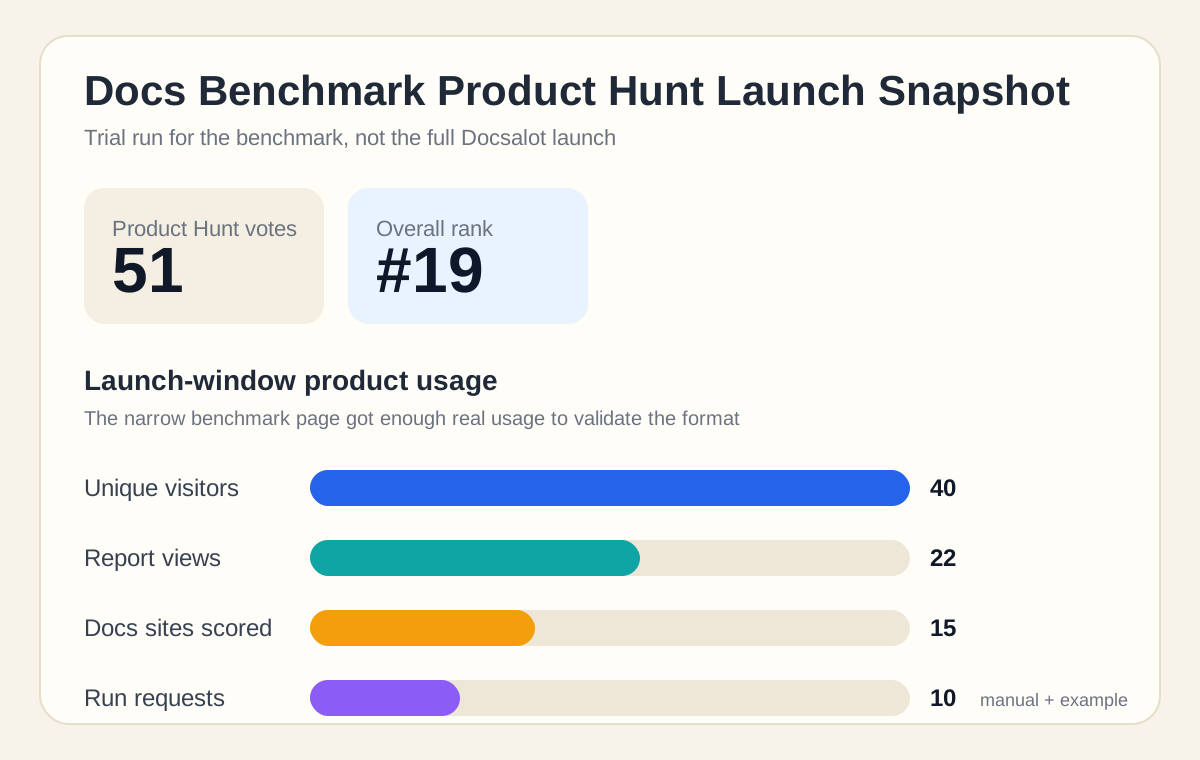
I launched Agent-Ready Docs Benchmark on Product Hunt without paying a hunter, influencers, or anyone else to push it. It ended with 51 votes and #19 overall.
This was not a paid launch. I did not pay a hunter. I did not pay influencers. I did not run ads. I shared it myself, messaged people directly, posted on LinkedIn and X, and dropped it into WhatsApp and Slack groups I am part of.
The short version is that Product Hunt is less of a neutral leaderboard than I thought. It is a one-day distribution event. The product matters, but so do your private network, the way you ask for support, and whether the platform gives you enough visibility to matter.
If you want the plain answer to the title, my answer was 51 votes and a #19 finish. That is what this launch produced without paying anyone. The rest of this post is about what seemed to drive that result and what I would do differently next time.
I wanted a trial run, not a perfect launch
I picked the benchmark because I wanted a narrow product surface for the experiment. I wanted to see how Product Hunt behaves when the product is easy to describe, the ask is simple, and the launch is mostly about learning.
The page got real attention, people actually used the product, and the launch was concrete enough to tell me something useful. It was a good reminder that narrow products are often better launch vehicles because they are easier for other people to understand and easier for you to evaluate honestly.
The launch was more private than public
The biggest lesson is that LinkedIn DMs were probably the main driver of votes. That is not a very glamorous answer, but I think it is the right one.
I cannot prove that cleanly with analytics because most of this lives inside direct messages, copied links, group chats, and other dark social channels. But when I compare the weak contribution from X with the responses I got from people I reached out to directly, the pattern is pretty obvious. LinkedIn DMs did more work than public posting. WhatsApp groups and Slack groups helped as well. X barely moved the needle. It likely contributed only 3 or 4 votes in total.
That was useful to learn because it changed how I think about launch-day effort. I would now treat direct outreach as the main channel, not as a supporting tactic around public posting.
This also changed my mental model of Product Hunt a bit. From the outside, it can look like a public internet event driven by homepage exposure and social momentum. In practice, at least for me, it behaved much more like a private trust event compressed into one day. A lot of the real movement happened in inboxes, chats, and small groups, not out in the open.
Being featured matters more than I thought
The other big lesson is that being featured matters more than I thought. This came up repeatedly in conversations with other founders. A lot of people said some version of the same thing: if you are not featured by Product Hunt, the launch gets much harder, and some founders will even cancel and relaunch rather than waste the day.
That sounded a little dramatic to me before this launch. It sounds much less dramatic now. The more I looked into it, the more obvious it became that visibility on Product Hunt is not evenly distributed.
Product Hunt is not just a neutral scoreboard for product quality. It is a distribution system with its own visibility rules. Once I accepted that, the outcome made a lot more sense. If I do this again, I will treat featuring as part of the launch plan itself because it can make or break the launch, not just as a nice bonus if it happens.
I had to separate launch-day signal from post-launch noise
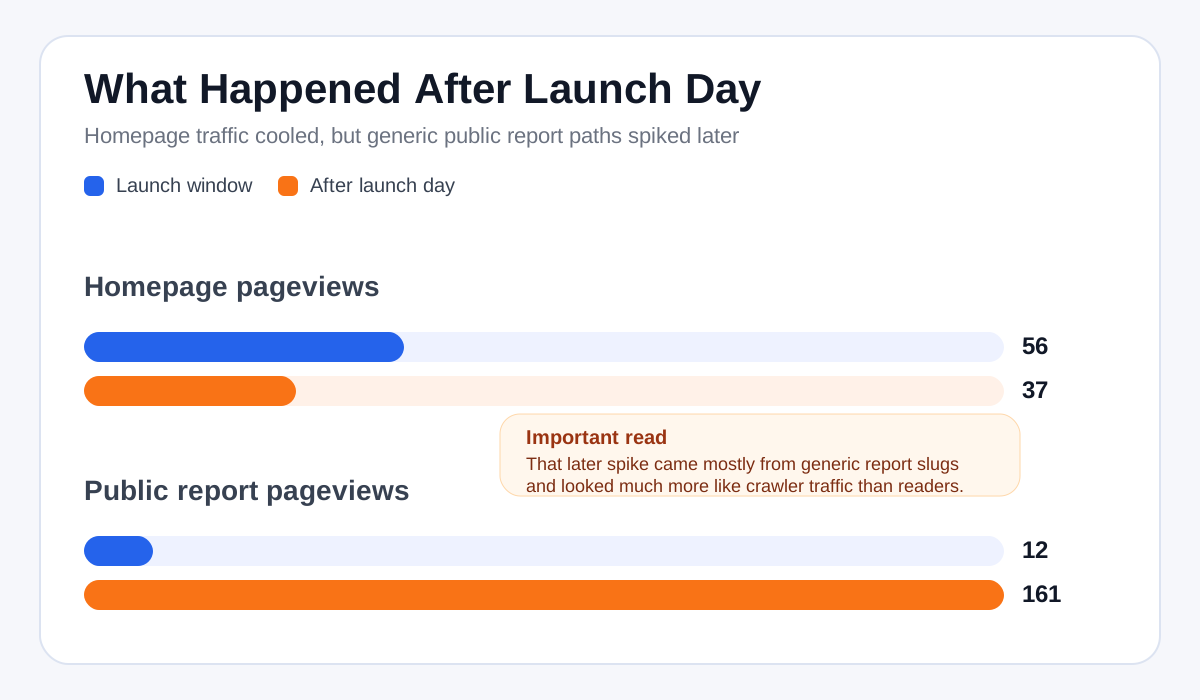
One thing I am glad I checked carefully was what happened after the launch day. I went through the traffic and made sure to separate the launch-day traffic from the post-launch noise so I could see the carryover effects more clearly.
Every run on the benchmark creates a public report slug, so there is a natural second wave once people start sharing those links around. But those pages also attract crawlers and probes, which means not all carryover traffic should be read the same way.
What I would do differently next time
If I run another Product Hunt launch, I would change a few things.
First, I would build the launch around direct outreach from the beginning. I would prepare the contact list earlier, write shorter asks, and spend more time on the people who are actually likely to show up.
Second, I would treat featuring as a core part of the plan. I would not assume that a good product is enough to get featured. This thread has some insights about how PH decides who to feature, and I would use that to inform the launch strategy. I would also prepare for the possibility of not being featured and have a backup plan for how to get visibility in that case.
Some tricks other founders have mentioned include being active on Product Hunt before the launch, engaging with the community, and reaching out to the PH team directly to build relationships. Getting hunted by a well-known hunter can help too if you are willing to pay someone or know someone.
Finally, some people hire a dedicated "launch guy" just for launch day to focus on outreach, monitoring, and engagement. That might be worth considering if the stakes are high enough.
Final take
My simple conclusion is that Product Hunt was useful for exactly what I needed from it. It let me run a trial launch on a narrow product, learn how much direct outreach matters, and see how much of the outcome depends on visibility inside the platform.
The TLDR is this: LinkedIn DMs mattered more than public social. WhatsApp and Slack groups helped. X did very little. Being featured matters a lot. If I want a better result next time, I need to treat distribution and launch mechanics with the same seriousness as the product page itself. Product Hunt also discounts upvotes from newly created accounts, so if people want to support you, have them create their accounts a few weeks before launch.
I am also genuinely grateful for every one of those 51 votes. That number is still small enough that it feels personal. I can roughly tell who many of those people were, and I know they took a moment to support something I built. I do not take that lightly.